
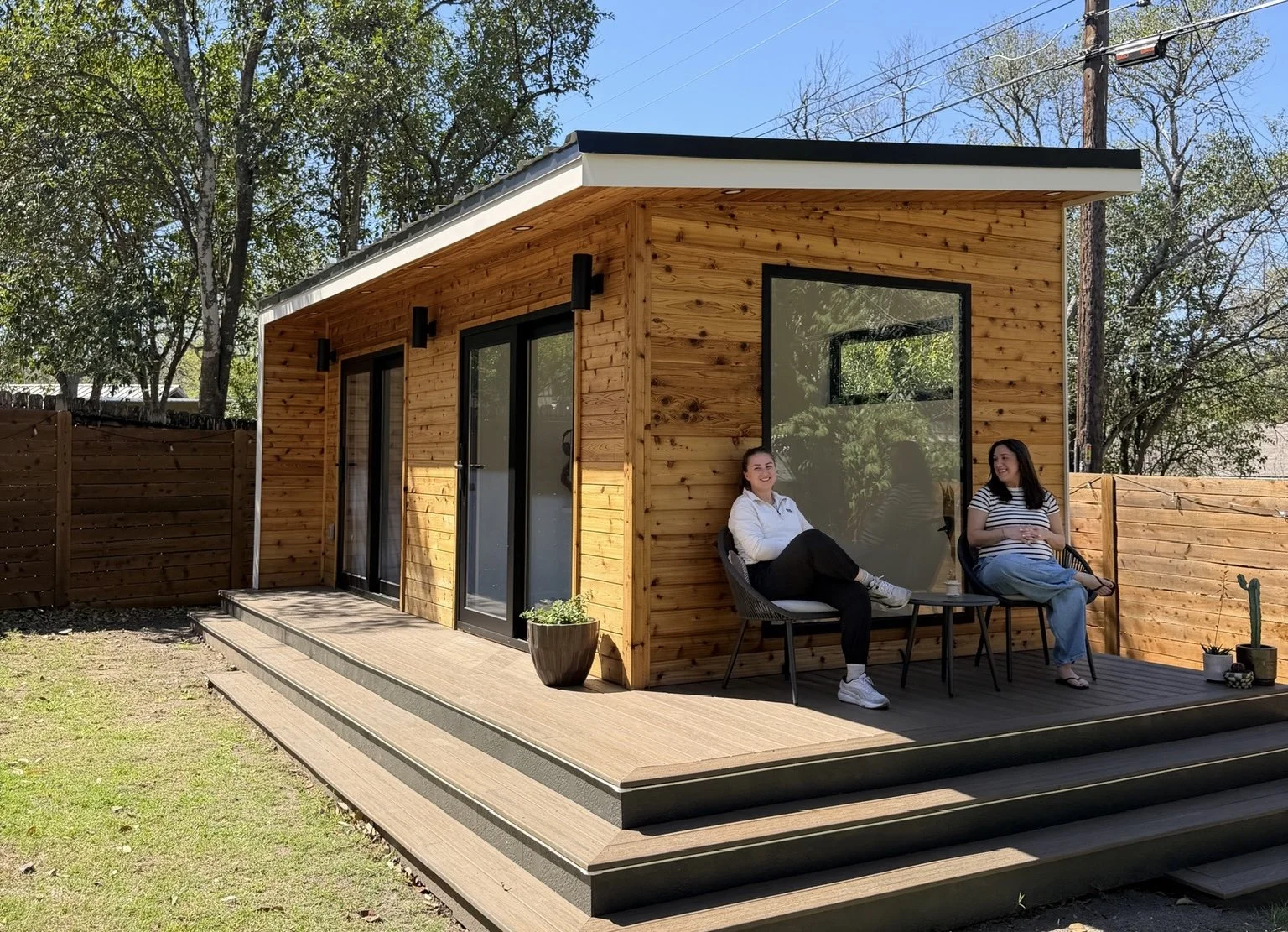
Backyard Office vs. Home Addition: The Smarter Way to Add Space Without Major Construction
Home addition or backyard office? Compare cost, timeline, disruption, and permits — then decide which actually makes sense for your work-from-home setup in Texas.
Your dining table has become your permanent desk. You're taking client calls from a closet. You've Googled "home addition cost" at least twice this week. You know you need more space — the question is which path gets you there without draining your savings or turning your house into a construction zone for the next year.
Two solutions keep coming up: build a home addition, or add a detached backyard office. Both can work. But they are very different projects in terms of cost, timeline, disruption, and what you actually end up with.
This guide breaks down both options honestly — with real numbers, realistic timelines, and a clear framework for deciding which one makes sense for your situation.
What You're Really Comparing
A home addition expands your existing house — adding square footage that is physically connected to and continuous with your living space. An attached home office addition becomes part of your home's official recorded living area.
A detached backyard office pod is a separate structure on your property — its own space, its own climate control, its own entrance. It's not counted in your home's recorded living square footage, but it adds real, fully functional, usable space.
Both approaches add usable space. But how they get you there — and what the experience of getting there looks like — is radically different.
| Category | Home Addition | Backyard Pod |
|---|---|---|
| Cost | $40,000–$120,000+ | $35,990–$55,990 all-in |
| Timeline | 6–18 months | 4–8 weeks |
| Disruption | High — crew inside your home | Minimal — one-day installation |
| Permitting | Full building permit, multiple inspections | Electrical permit only (~$1,000) |
| Work/Life Separation | Still inside the house | Fully detached — physical boundary |
Cost: What You'll Actually Spend
Home Addition Costs in Austin
Home additions are among the most expensive residential construction projects on a per-square-foot basis. In Austin, expect to pay $200–$400 per square foot for a finished addition — and that range can escalate.
A modest 200 sq. ft. addition (roughly the size of a functional home office) costs $40,000–$80,000 in Austin before accounting for:
- Architect fees — typically 8–15% of construction cost
- Permit fees — which vary based on project scope
- Cost overruns — construction projects in Texas routinely run 10–20% over initial estimates
If the project requires moving plumbing, relocating electrical panels, reinforcing the existing foundation, or integrating with your HVAC system, costs climb further. A 300 sq. ft. addition with quality finishes, HVAC tie-in, and a proper home office setup in Austin can easily exceed $120,000.
Backyard Office Pod Costs
A turn-key backyard office pod from Backyard Pod starts at $35,990 and reaches $55,990 for the largest model — all-inclusive. That price covers foundation, installation, climate-controlled mini-split HVAC, a 2-foot deck, all interior finishes, sliding glass door, and windows. No surprises, no change orders, no contractor overruns.
Financing is available through local lenders at up to 80% of the combined appraised value of your home and the new pod. Monthly payments start around $189. Compare that to the interest on a $100,000+ home equity loan required for a comparable addition.
Timeline: How Long Before You Can Actually Use the Space?
Home Addition Timeline
A home addition involves multiple sequential phases — and each one can be delayed by contractor availability, permit processing times, weather, material lead times, and inspection scheduling. None of these phases can overlap.
| Phase | Realistic Duration |
|---|---|
| Design and architecture | 4–8 weeks |
| Permit review and approval | 4–12 weeks (Austin) |
| Foundation and framing | 3–6 weeks |
| Rough electrical, plumbing, HVAC | 2–4 weeks |
| Inspections | 1–3 weeks |
| Insulation, drywall, and finishes | 4–8 weeks |
| Total | 6–18 months |
That "6 months" end of the range assumes everything goes right. In practice, a home addition that hits its minimum timeline is the exception, not the rule.
Backyard Office Pod Timeline
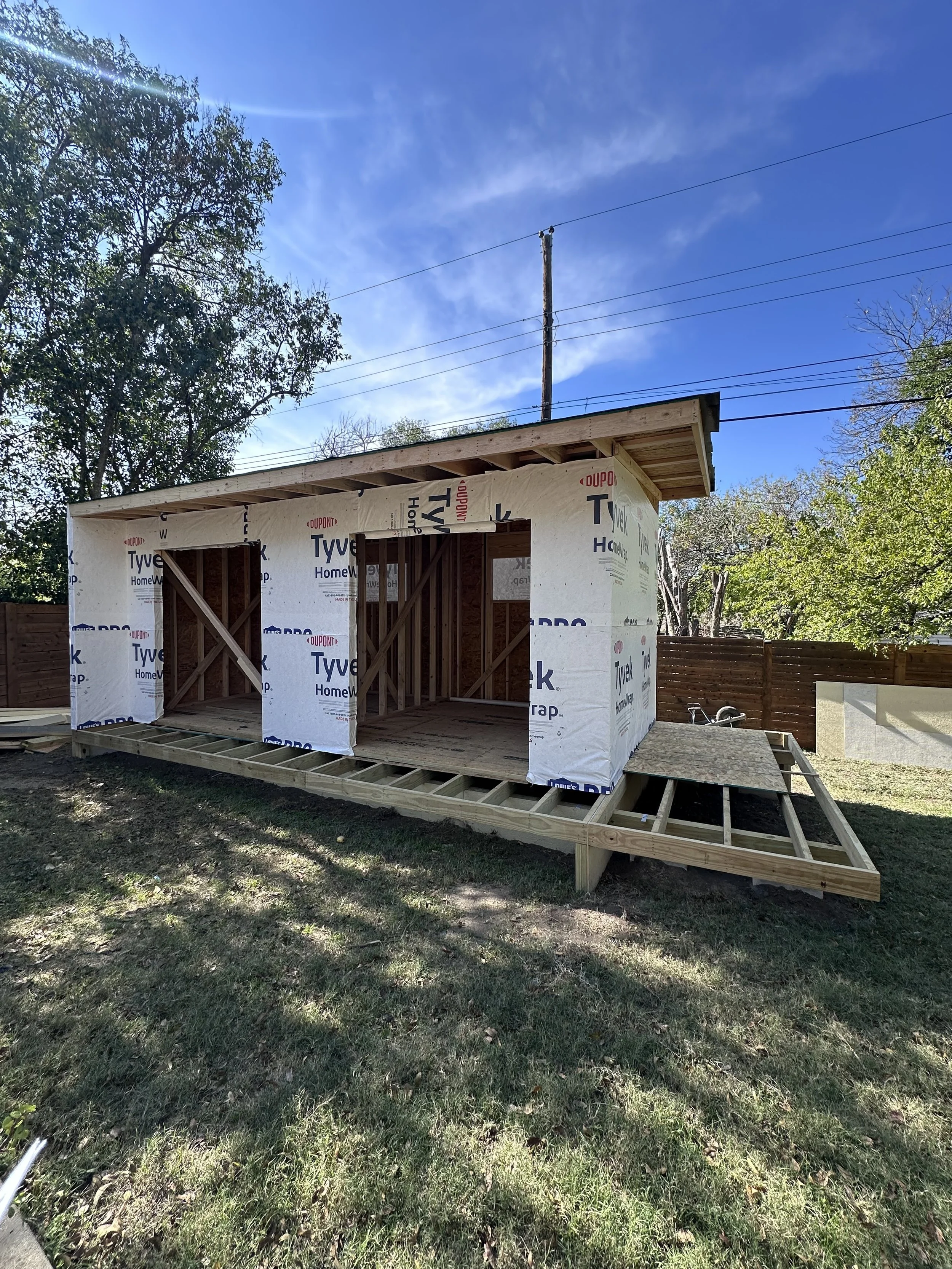
Backyard Pod's all-inclusive process runs from initial consultation to move-in day in 4–8 weeks. The pod is manufactured to your specifications while the foundation is being prepared. The structure is installed in a single day. Electrical connection follows within a few days of installation.
Timeline reality check: If you need workspace now — not in 12 months — the timeline comparison may settle the question entirely. A home addition won't solve a Q1 work-from-home problem by spring. With Backyard Pod: call Monday, working in your new office in as fast as 6 weeks.
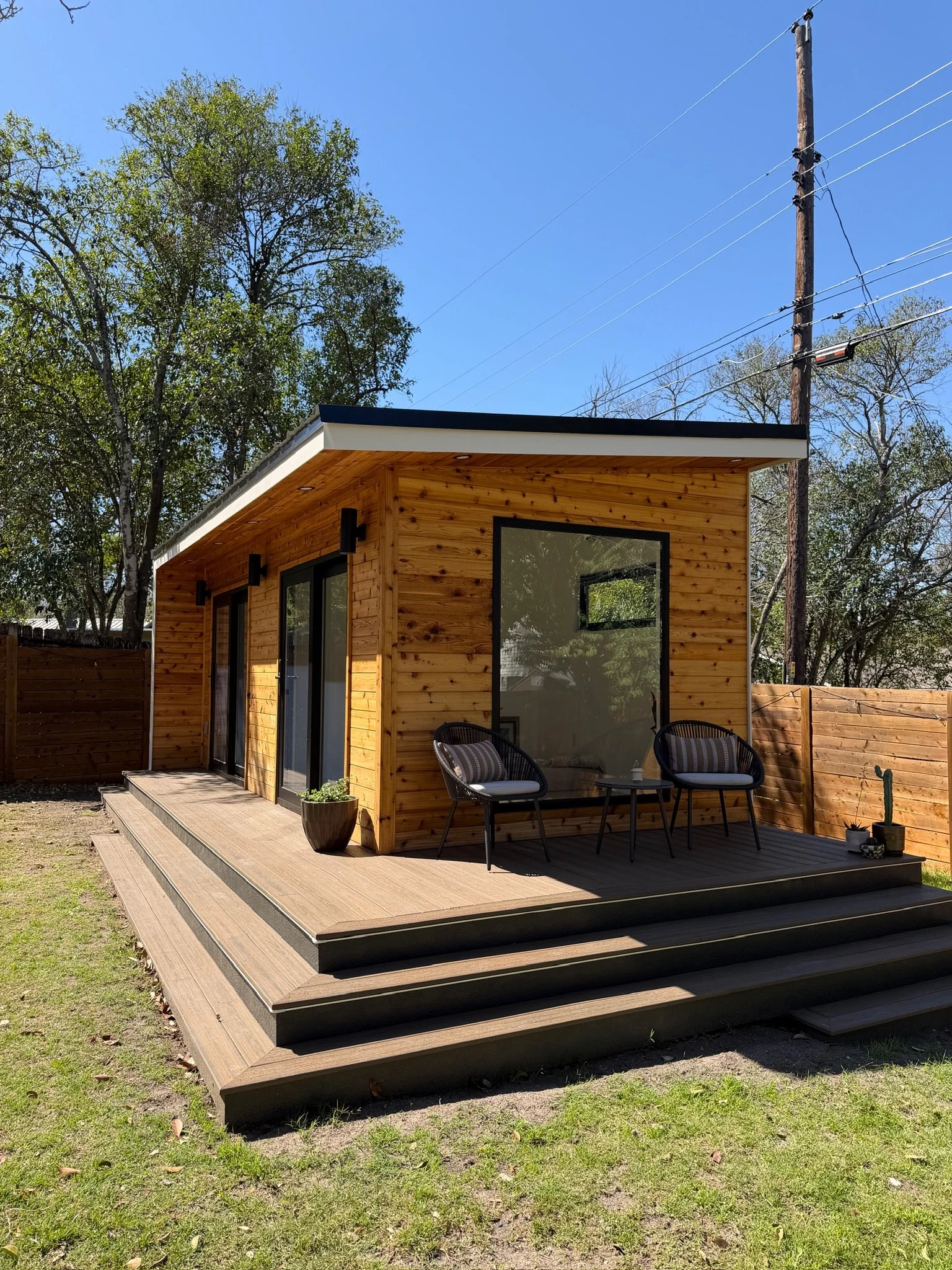
A finished Backyard Pod — installed, furnished, and ready in weeks, not months.
Disruption: What the Process Actually Feels Like
Home additions are notoriously disruptive. Contractors work inside and adjacent to your home for months. Walls are opened. Noise is constant. Dust migrates into every room. Your daily routines get turned upside down — and if you're already working from home, the problem compounds: you're trying to take video calls while a nail gun is firing 20 feet away.
A backyard office pod installation happens entirely outside your home. The crew preps the foundation, delivers the pod, and installs it in a single day. Your house is never opened. You continue using every room normally throughout the entire process. The most disruptive part is one afternoon when the installation crew is working in your backyard.
Permitting: Simple vs. Complex
A home addition requires a full building permit: architectural drawings, structural plans, and sometimes engineer certifications. Austin's permit review process for additions can take 4–12 weeks. After approval, expect inspections at multiple construction stages — foundation, framing, rough electrical and plumbing, and final completion. A failed inspection at any stage adds more weeks.
A backyard office pod under 200 sq. ft. in Austin typically requires only an electrical permit — approximately $1,000 — which Backyard Pod handles as part of the project. No architectural drawings. No framing inspections. No months in permit review.
Work/Life Separation: The Hidden Benefit of Detached
One of the most underrated advantages of a detached backyard office is psychological: the commute.
Even a 30-second walk from your back door to your office pod creates a mental transition that an in-home addition simply cannot replicate. Remote workers who move from a home office inside their house to a detached structure consistently report better focus, clearer boundaries between work and personal time, and reduced stress. Stanford researcher Nicholas Bloom — one of the most-cited experts on remote work — has noted that physical separation between living and working spaces is one of the key factors in remote work productivity.
A home addition is still inside your house. You hear the TV, the kids, the dog. A detached pod is your space — quiet, separate, yours.
Resale Value: Does It Add to Your Home's Worth?
A home addition increases your home's official recorded square footage and is reflected in the county appraisal. This typically raises the assessed value and sale price. However, cost recovery on additions is imperfect — homeowners typically recover 50–75% of addition costs at resale.
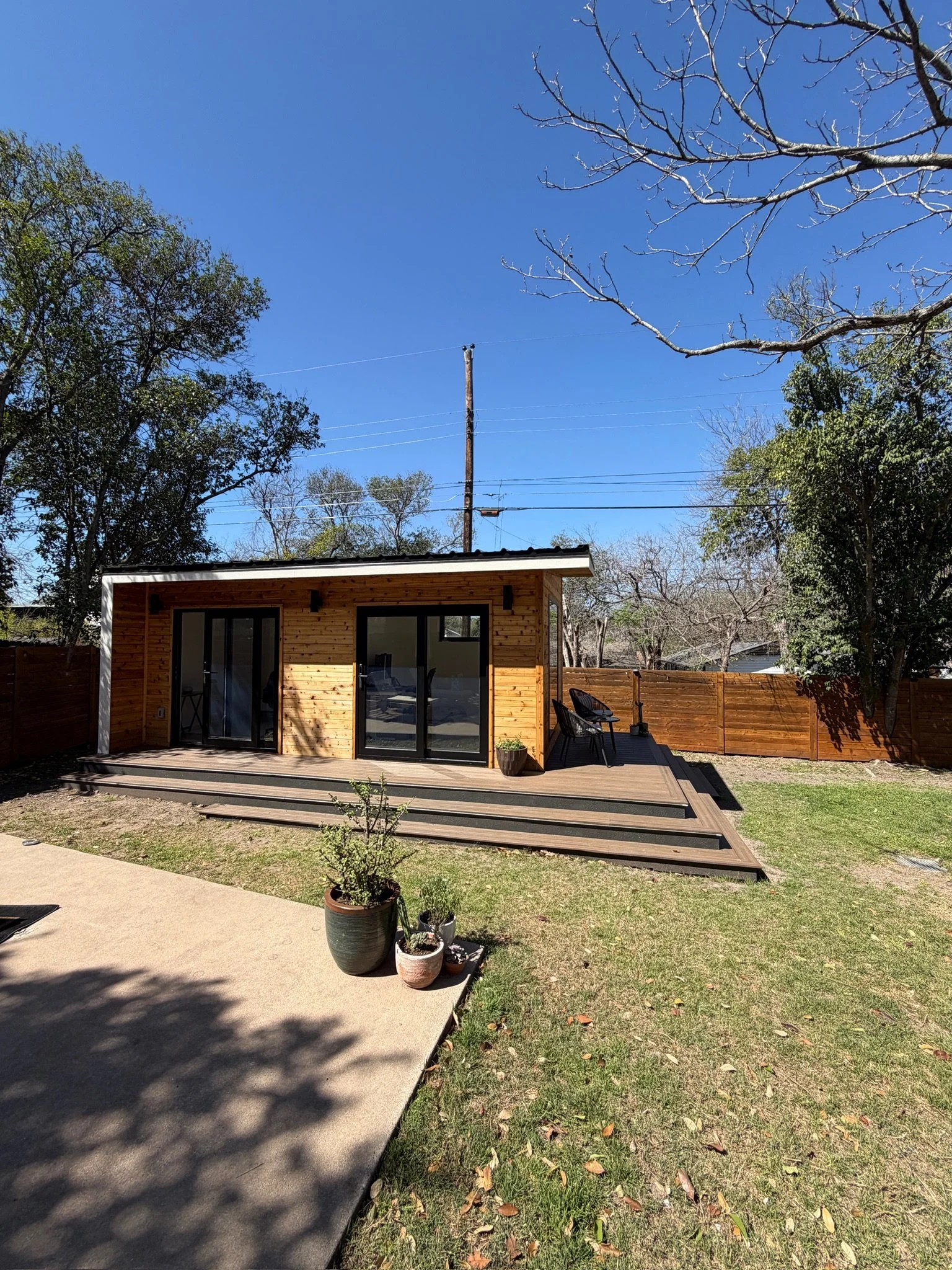
A backyard office pod doesn't add to recorded living square footage, but it adds meaningful lifestyle value and strong buyer appeal in the Austin market — particularly among remote-work buyers, which is a large and growing segment of Austin's professional home-buying population. Many Austin buyers actively seek properties with a dedicated detached workspace, and a well-finished pod can meaningfully differentiate your listing in a competitive market. Homes with Pods sell much faster and with a premium!
When a Home Addition Makes More Sense
A home addition is the right call when:
- You need more than 200 sq. ft. of additional connected living space (master suites, family rooms, multiple bedrooms)
- The new space must be physically linked to the main house — for a family member's bedroom, an expanded kitchen, or accessible living
- You need to add plumbing (a bathroom, laundry, or kitchenette) that integrates with your home's existing systems
- Your goal is specifically to increase your home's recorded square footage for appraisal purposes
- Your lot is too small to accommodate a detached structure while meeting local setback requirements
The Bottom Line
Home additions and backyard office pods solve the same fundamental problem — more usable space — but they're entirely different projects in cost, timeline, and day-to-day experience. For dedicated workspaces, home gyms, studios, or hobby rooms under 200 sq. ft., a backyard pod is almost always faster, less expensive, and far less disruptive. Home additions are the right choice when you need living space that integrates directly with the main house.
Know what you actually need — then choose the tool that fits.
See What a Backyard Pod Can Do for Your Home
Five models ranging from $35,990 to $55,990, installed in 4–8 weeks across the Austin metro.
All-inclusive pricing. Permitting handled. No surprises.
Explore Models & Schedule Free Consultation